Appearance
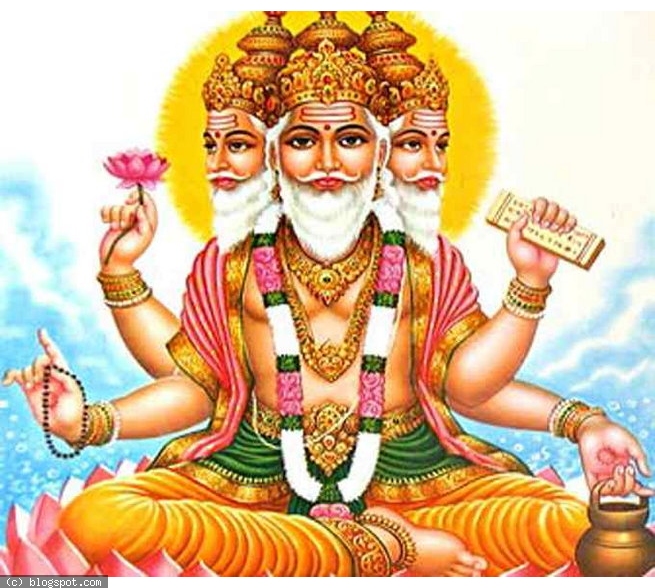 He is clad in red clothes. Brahmā is traditionally depicted with four heads, four faces, and four arms. With each head, He continually recites one of the four Vedas. He is often depicted with a white beard (especially in North India), indicating the nearly eternal nature of his existence. Unlike most other Hindu gods, Brahmā holds no weapons. One of his hands holds a scepter. Another of his hands holds a book. Brahmā also holds a string of prayer beads called the 'akṣamālā' (literally "garland of eyes"), which He uses to keep track of the Universe's time. He is also shown holding the Vedas.
There are many other stories in the Purāṇas about the gradual decrease in Brahmā's importance. Followers of Hinduism believe that humans cannot afford to lose the blessings of Brahmā and Sarasvati, without whom the populace would lack creativity, knowledge to solve mankind's woes. There is a story of a fifth head. This head came when Shatrupa started flying away from him upwards and the head came on top of the four heads - symbolizing lust and ego, the head was decapitated by Shiva returning Brahmā to his four head avatar which gave birth to the Vedas. The fifth head stayed with Shiva hence Shiva got the name Kampala.
Symbols
-
The Four Faces – The four Vedas (Rig, Sāma, Yajur and Atharva).
-
The Four Hands – Brahmā's four arms represent the four cardinal directions: east, south, west, and north. The back right hand represents mind, the back left hand represents intellect, the front right hand is ego, and the front left hand is self-confidence.
-
The Prayer beads – Symbolize the substances used in the process of creation.
-
The Book – The book symbolizes knowledge.
-
The Gold – Gold symbolizes activity; the golden face of Brahmā indicates that He is actively involved in the process of creating the Universe.
-
The Swan – The swan is the symbol of grace and discernment. Brahmā uses the swan as his vāhana, or his carrier or vehicle.
-
The Crown – Brahmā's crown indicates His supreme authority.
-
The Lotus – The lotus symbolizes nature and the living essence of all things and beings in the Universe.
-
The Beard – Brahmā's black or white beard denotes wisdom and the eternal process of creation.
Vehicle
Brahma's vehicle or vāhana is the hansa, a swan or a goose.
Brahma fails to measure the height of Shiva Linga- It is believed that once Lord Shiva stood in the form of a great Linga with deep roots into the womb of the mother earth and with the top far above the skies. Brahma and Vishnu threw each other a challenge that whoever finds the top or bottom of the Linga, will be considered as supreme. Accordingly Brahma took the form of a swan and flew into the sky. Vishnu took the form of a boar and began digging deep into the earth. They spent a lot of time but could not reach the top or bottom of the Linga. However to show that he was superior, Brahma told a lie that he had touched the top of the Linga. A flower called Ketaki stood as a witness to the statement of Lord Brahma. Listening to these words Shiva became very angry and cursed Brahma that he would never be worshiped by any human being. He cursed the false witness, the Ketaki flower also, saying that the flower will not be used in the worship of any God or Goddess or in any holy activity.That is why they say that there are not more than 14 or 15 temples of Brahma, where as there are lakhs of temples for Shiva or Vishnu.
Lord Brahma is reverentially addressed as Pitamaha (father of fathers) by devas, demons, and humans. Since Brahma is also a Prajapati all these people used to visit him . According to the Upanishads the Lord used to teach the Vedas and the importance of virtue to these people. They all used to spend considerable time with him to acquire knowledge of the Atman. He also taught three important virtues to his three types of students. Once He uttered a single syllable ‘da’ and asked them to grasp its meaning. The gods interpreted the sound as the word as 'datta' meaning to give away all pleasure seeking activities. The humans interpreted the syllable as 'dayadhwam' which means ‘to show mercy’ by leaving out their greedy and selfish activities. The demons interpreted the sound as 'damyata' meaning control or suppression of cruel attitudes and passions.
Lord Brahma the God of Destiny or Fate: Lord Brahma is also called as Vidhi, DhAtA, and VidhAtA. Vidhi means the Ordainer. Vidhata means disposer,ordainer, Arranger,or Law-maker. He is also called as Twasta, Viswadeva. According to the Veda- Yo Vidhata cha Dhata cha- ( Vidhata is also called as Dhata). He is also called as Vedhasa- ( Vidhata Vedhasamapi). Vidhata means the governor of Nature’s Laws relating to the journey of the Soul. Lord Brahma is not only the creator as mentioned in the Purusha Sukta, but also the decider of the destiny or Fate of the beings that are going to be born . Brahma is the God who writes the fortunes of everybody based on the KARMA or deeds in the previous births. Fate, or luck or destiny ordained by Lord Brahma and written by him in a coded language on the forehead of every individual cannot be altered by anybody. Because one has to reap what one has sown. It is believed that Brahma examines the Karma of every being in his previous births and accordingly decides what should be the fate of the individual in the present birth. Brahma’s writings on the forehead can be understood only by great Yogis or Rishis when they look at the forehead of any person. That is why they look at the face of a person carefully before they bless a person with long life, good health, wealth and progeny etc. The Fate in reality is a product of the Karma of one’s previous lives. The unfinished Karma is carried forward to the next birth. Sanchita-Karma into which God Brahma looks carefully, Lord Brahma is the sum-total of the accumulated Karma of previous births. It is in one’s account and needs to be cleared at some stage in one’s spiritual journey. Prarabdha karma is that part of the Sanchita Karma which is posted to the present birth by Lord Brahma and hence it has to be cleared in this birth only. This concept has sometimes led to the philosophy of Fatalism and some scholars began to argue that since everything is pre-ordained why should we run here and there to alter our future. In the Upaishads Lord Brahma is also depicted as the immortal Lord of Heaven who receives the liberated souls at the end of their journey along the Northern path.